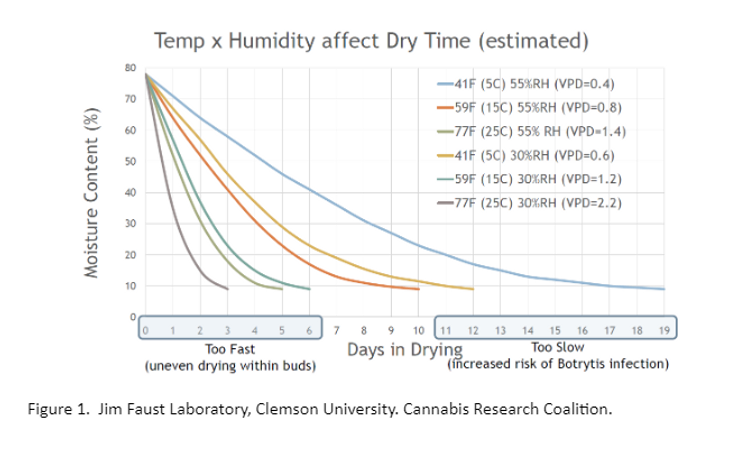
Targeting 0.8–1.1 kPa, the range recommended by the drying-rate data below 2.
Advanced: override the target VPD range
Only change this if you have a specific reason to dry faster or slower than recommended.
VPD 0.00 kPa
Status:
Rough estimate based on VPD alone; actual dry time also depends on airflow, bud density and how flower is hung or racked. Assumes gentle, steady airflow rather than still air.
What is VPD?
Vapor pressure deficit is the difference between how much moisture the air could hold at a given temperature and how much it actually holds. A higher VPD pulls moisture out of your flower faster; a lower VPD pulls more slowly. Because it accounts for temperature and humidity together, VPD is a better guide for drying than watching either number on its own.
Why 0.8–1.1 kPa
Based on the drying-rate data below, VPD readings under about 0.7 kPa commonly take more than 11 days to dry, which raises the risk of mold and bud rot. Readings above about 1.2 kPa commonly dry in under 6 days, which can dry the outside of a bud before the inside is ready, trapping moisture and curing unevenly. The 0.8–1.1 kPa window sits between those two failure modes.
Reference 1 recommends drying at 18–21°C (64–70°F) 1. No source we found pins an exact temperature where terpenes start evaporating. Loss is understood to increase gradually with heat rather than switch on at a fixed point, but staying in that recommended band is a reasonable precaution.
Wet-to-dry weight estimator
Estimate final dry weight from what you weigh right after harvest, based on typical moisture content.
Defaults from reference 1: fresh cannabis is about 80% water, and most growers stop drying around 10–11% 1
Estimated dry weight 0 g
Rough estimate from typical moisture percentages, not a measurement. Actual retention varies by strain, bud density, and how tightly the harvest is trimmed.